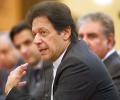
Pak claimed that the Indian Prime Minister's 'internal politics' do not permit him to extend an invitation to his Pakistani counterpart.

'Modi wants to be pragmatic -- acknowledge the problem of Pakistan and that full reconciliation is essentially a non-starter, but at the same time grab the low-hanging fruits (such as trade) to put things on a more even keel, to engender enough stability in the relationship to allow him to focus on other priorities.'
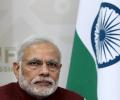
'There is nothing that Pakistan has done which deserves a resumption of dialogue. The assurances made in Ufa contain no commitment except a whole range of talks, which could take place without the paraphernalia associated with a joint statement of prime ministers.'

As Modi prepares for his first meeting with United States President Donald Trump, we can't help but wonder will the PM go in for a hug or will 'The Donald' opt for one his 'famous' handshakes?

'The entire Ufa fiasco was predictable and predicted. The Ufa venue had created international interest in the initiative and its failure may have implications for both Pakistan and India. What remains for Modi to do is to produce a prettier rabbit out of his hat next time to deal with the Pakistan imbroglio,' says Ambassador T P Sreenivasan.

Don't be surprised if Imran invites Modi and other South Asian leaders for his swearing-in ceremony, says Colonel Anil A Athale (retd).

'The biggest stumbling block will come from the traditionalists in the Pakistan army who have grown on a diet of anti-Indian propaganda and thinking on which much of their role -- both militarily and politically -- is centered upon.'

'From his persistent fuelling of pan-Hindu nationalism to pandering to narrow Gujarati chauvinism, Rambo rides again, using fair means and foul -- and often foul -- to gain the battleground,' says Sunil Sethi.

Determined to oust Pakistan Prime Minister Nawaz Sharif, tens of thousands of protesters on Friday marched towards the capital in two separate convoys as clashes erupted with opposition leader Imran Khan claiming that ruling PML-N activists fired at his vehicle.

'A class antagonism of rich versus poor took the colouring of a communal confrontation,' says Sunil Sethi.

The BJP tweeted a video of Rahul Gandhi apparently at a nightclub in Nepal, inviting a strong response from the Congress which said he was in the friendly country to attend the marriage function of a journalist friend and that it is not a crime to attend weddings of family and friends.
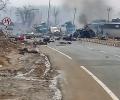
Pakistan has taken too much of a chance with Pulwama - with the wrong government in India, and at the wrong time.
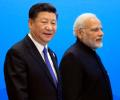
'There is a compulsion to look hard, decisive, and risk-taking; start something; and then conclude it in a way you can claim victory.' 'That is not such an easy option against China,' notes Shekhar Gupta.

India looks less equal to China than 5 years ago, the strategic alliance with the US is hobbled by trade, and Pakistan is looking anything but chastened by Balakot. What has gone wrong? asks Shekhar Gupta.
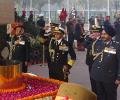
''At this stage we are closer to military confrontation than at any time since 1971.' 'Given the known positions of the two governments, it will not be surprising if this happens sooner rather than later,' says Vice Admiral Premvir Das (retd).

'It sounds hollow when the military -- the last bastion meant to secure India within the State of India -- is itself not found secure on the third day of the Pathankot strike, in spite of so-called definitive intelligence inputs and preparations,' says Lieutenant General Anil Chait (retd), former chief of the Integrated Defence Staff.

'All this talk of 'tactical nuclear weapons' or a limited nuclear war are 'false flags'! It looks like India and Pakistan are slowly but surely inching towards this realism,' says Colonel Anil A Athale (retd).

'Pakistan may feel emboldened to give an upswing to the proxy war in J&K, having secured a better international consensus on its strategic importance.' 'The raising of Pakistani flags by separatists in J&K is an attempt to win psychological space and more of this can be expected as we go into the summer.' 'Pakistan should remain warned that pushing India on this issue will be dangerous.'
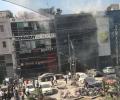
Punjab Law Minister Rana Sanaullah said the blast seemed to be aimed at sabotaging the Pakistan Super League final in Lahore.
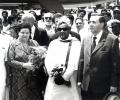
'I was present at a meeting where he decided to permit the IAF to strike at Pakistan positions in Kargil, with the caveat that they should not cross the LoC.' 'Confident that the Indian Army would succeed, Mr Vajpayee was positioning himself to tell the world after the Kargil conflict was won that India did not violate the 'sanctity' of the LoC,' recalls Ambassador G Parthasarathy, who served as India's envoy in Islamabad in that eventful year, 1999.

Prime Minister Modi made a strategic blunder of Nehruvian proportions -- presuming no war can happen now, and the Chinese won't be a military threat and risk their economic interests, observes Shekhar Gupta.

'While the meeting on December 6th was perfectly legal, was it ethical?' asks Colonel Anil A Athale (retd).

Congress on Monday demanded that Prime Minister Narendra Modi "break his silence" over the alleged "provocative" statements by the Bharatiya Janata Party leaders in connection with the Dadri lynching, saying that not doing so would suggest that they had his "approval".

'Diplomatic engagement will continue even as India keeps all its options open with respect to discretely targeting the Pakistani military and its terrorist proxies.'
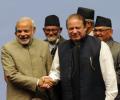
'Modi has said he has been made the PM of India not to do small things but big things. What bigger thing can there be than to have peace with Pakistan and in the neighbourhood?'

'If the school of bluffers includes those who get to the top not from deep knowledge but from delivering 'a clever quip or a leftfield surprise argument', then Modi is the undisputed Bluffocrat Emeritus,' says Sunil Sethi.
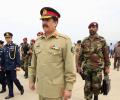
'This army has lost Pakistan's territory, ideology, financial and intellectual capital, ruined its institutions, democracy, the respect for its passport and, like it or not, reduced its status to a globally acknowledged university of jihad,' says Shekhar Gupta.

Blackmail on one side and bullying on the other doesn't make for a constructive partnership, says Sunanda K Datta-Ray.

'We should not have waited for the political crisis in Nepal to erupt before being galvanised into action,' says Shyam Saran. 'We should have seen what was coming and not accepted assurances from the leaders of the political parties at their face value.'
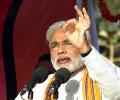
'Both reflect prejudice and short-sightedness peculiar to Mr Modi's way of thinking.'
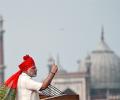
'Independence Day has been India's annual general meeting. For the most part, it has been a forgettable experience of ritual observances. Not so this year... Mr Modi instead presented what I call a moral balance sheet of India,' says Shreekant Sambrani.

Read what the ex-chief of R&AW, A S Dulat, told our readers on Rediff Chat!

While Prime Minister Modi may pursue the laudable aim of building a cooperative relationship with Pakistan, he and his advisers should never think that concessions (and dialogue is a concession in itself) will change the Pakistan army's approach to India, says Vivek Katju.

'The only quality required in this tenure is to be the military's yes man and that he has the capacity to do so.'

World leaders are reacting with caution to Donald Trump's jaw-dropping victory in the US presidential election, with some of them reminding him of the democratic values and the global responsibility he carries.

'He could indeed survive [the no confidence vote] even as he faces his biggest political test.'

Girls in the Kashmir valley hurling defiance at the security forces will detract from the legitimacy of India's response and its standing in the world, says Ajai Shukla.

B S Prakash takes a tongue-in-cheek look at what India's neighbours think about the proposal of a SAARC satellite.

'We are completely engaged in fighting poverty; alas, our neighbour Pakistan seems only engaged in fighting us.'

'Pakistan needs to be constantly at war with somebody, ultimately resulting in it waging war on itself and its own people,' says Shekhar Gupta.
